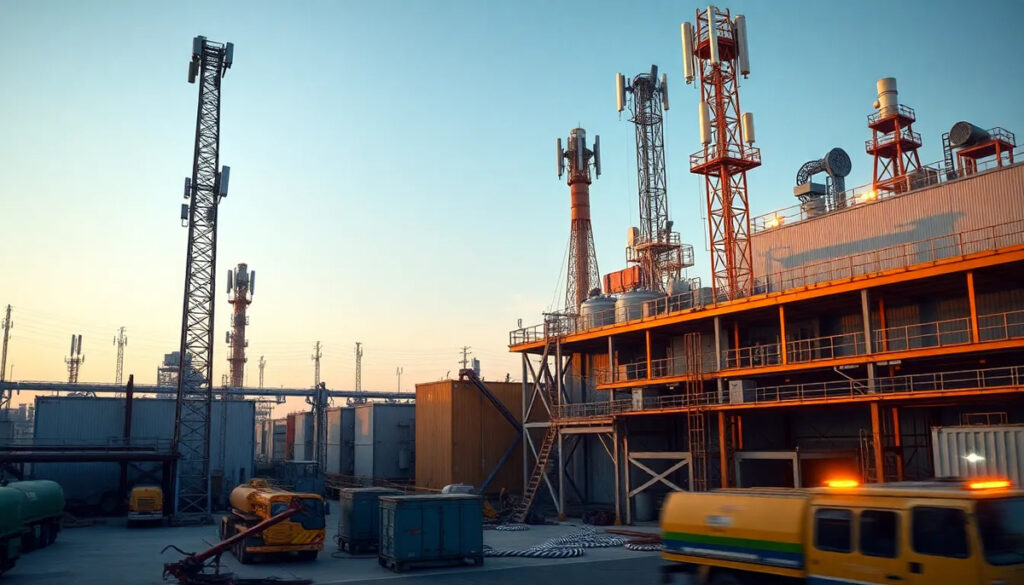
Everyone is talking about autonomous systems right now. Driverless trucks. AI tractors. Yard vehicles that can move themselves without a cab in sight.
But here is the uncomfortable truth. The one thing most autonomy roadmaps forget is the thing that makes autonomy actually work.
Connectivity.
Not a SIM card. Not a patchy 5G signal. Not a Wi-Fi network held together by luck and cable ties.
Real connectivity. Industrial, mobile, resilient. The kind built for environments where failure is not an option.
Because autonomy without connectivity is not autonomy. It is a disconnected robot waiting to fail.
1. Autonomy Is Not a Closed System
There is a myth that autonomous vehicles operate in isolation. Give them sensors, GPS and an onboard brain and off they go.
That is not how real industrial autonomy works.
Autonomous systems rely on continuous, two-way communication for:
Live telemetry to operators and systems.
Sensor fusion across multiple sources.
Remote human intervention when judgement calls are needed.
Live video feeds for situational awareness.
Constant updates to navigation and tasking data.
Every single piece of that depends on a secure, mobile, always-on network.
If the network fails, the autonomous system fails. Full stop.
2. Why Traditional Networks Cannot Handle Autonomy
Autonomy is brutal on networks. It exposes every weakness instantly.
And consumer or enterprise-grade connectivity simply cannot cope. Here is why.
Wi-Fi has limited range, collapses outdoors and hates mobility.
4G and 5G suffer from patchy coverage, inconsistent latency and unpredictable throughput.
Fibre is excellent until the moment your autonomous vehicle needs to move more than ten metres.
Autonomous machines do not sit still. They roam across ports, pits, yards and farmland.
Which means your connectivity has to roam with them.
3. What an Autonomy-Ready Network Actually Looks Like
Strip away the buzzwords and the requirements are very clear.
You need a network that is mobile, self-healing and field-proven.
That means:
Wireless Mesh for a network that expands with every node, reroutes around failures and moves with the vehicle.
Backhaul Anywhere using Starlink or bonded LTE and 5G so data can flow to HQ no matter how remote the site is.
Edge Compute so vehicles can process vision, LIDAR and obstacle detection locally, even without backhaul.
Zero Trust Security because autonomous systems are attack surfaces, not toys.
Put these together and you get a foundation that can scale, adapt and survive real industrial conditions.

4. How Real Operators Are Using Connectivity to Power Autonomy
Mining teams run autonomous haul trucks with mesh nodes on towers and vehicles, keeping telemetry and video flowing across vast, shifting environments.
Rail yards use low-latency mesh for shunting and inspection units, with control rooms able to teleoperate instantly based on live video and positional data.
Agriculture relies on edge compute for round-the-clock autonomous tractors, supported by mesh coverage for telemetry and Starlink for remote oversight.
Ports keep moving cranes, stackers and vehicles connected across huge sites without relying on fragile Wi-Fi APs or static fibre links.
In every case, the network is not an extra. It is the system that makes the autonomy possible.
5. Planning an Autonomy Rollout? Connectivity Must Come First
If your autonomy plan does not have network infrastructure in the very first phase, the plan is flawed.
You can retrofit autonomy.
You can integrate AI.
You can automate tasks and upgrade sensors.
But if your machines cannot communicate in real time while moving, none of it matters.
Connectivity is not the accessory. It is the base layer.
Conclusion: Autonomy Only Works When the Network Works
You would not build a high-performance vehicle and forget the engine.
So do not build an autonomous system and forget the network.
If you want autonomy that is safe, scalable and ready for real industrial operations, you start with connectivity. You build a network that is mobile, resilient and proven. Then you layer autonomy on top.
Get the network right and everything else flows.
Get it wrong and nothing else will ever take off.