Logistics yards have a visibility problem, but not the one most people talk about.
The real issue is not lighting. It is information.
Every modern logistics operation runs on data.
Vehicle tracking. Driver movements. Bay allocation. Yard flow modelling. ANPR. Access control. CCTV. Asset monitoring. Sensor feeds. Environmental data. Telemetry. Safety alerts.
The demand for real time information has exploded, yet the infrastructure carrying that information has barely changed.
Data is scattered across boxes, poles and makeshift mounts. Some areas have strong connectivity, others are dead zones. Some sensors talk to each other, others operate in isolation. And every time a yard layout changes, half the infrastructure has to be moved, reconfigured or coaxed back to life.
It is messy, fragile and expensive.
And it is slowing everything down.
Intelligent lighting is quietly disrupting this entire model. Lighting poles are becoming the most reliable and underused network backbone in logistics yards. When lighting becomes a gateway for connectivity and edge compute, the whole operation changes.
This article breaks down how that shift is happening and what it means for site visibility, efficiency and scalability.
Logistics Yards Are Perfectly Placed for a New Type of Infrastructure
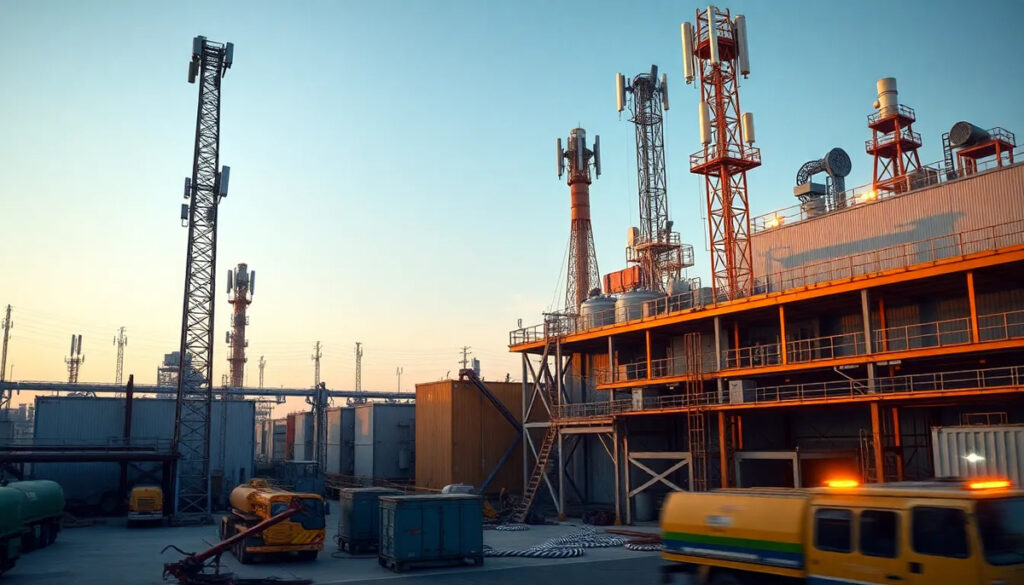
A logistics yard is essentially a micro-city.
It has entry points, traffic lanes, work zones, high-value assets, risk areas and unpredictable movement patterns. The one thing that remains consistent is the lighting grid.
Lighting poles are already everywhere.
They already have power.
They already cover the site evenly.
They already sit in the perfect physical locations for line-of-sight, sensor placement and wireless propagation.
Yet they remain unused beyond illumination.
When lighting becomes intelligent and modular, it solves the biggest connectivity challenge logistics yards face.
Not how to get data, but how to move it reliably across the site without installing separate infrastructure.
The Connectivity Gap in Modern Logistics
Most logistics hubs still rely on a collection of short-term fixes.
Point-to-point links.
Low-powered Wi-Fi repeaters.
Standalone sensors.
Temporary towers.
Cheap access points mounted wherever someone can reach with a ladder.
These systems work until the site changes.
And logistics sites change constantly.
The gaps become obvious:
Coverage Drops Whenever Layouts Change
Move a few trailers, reposition a bay or shift a line of racking and wireless coverage collapses in random pockets.
Sensor Networks Are Fragmented
Each system works, but none work together.
Access control, CCTV, telematics and yard management often run on separate islands of data.
Temporary Fixes Become Permanent Problems
Boxes strapped to poles, routers in waterproof tubs and consumer-grade hardware stuck under shelters all become long-term liabilities.
Data Moves Slowly
When connectivity is patchy, systems fall back to delayed sync, leaving decision makers with stale information.
The result is operational drag.
Not because people are slow, but because the infrastructure underneath them is.
Why Lighting Poles Are the Natural Fix
Lighting poles solve five connectivity challenges in one hit.
They Already Have Power
This removes the biggest barrier to expanding sensor networks.
They Are High Enough for Strong Coverage
Height improves line-of-sight.
Better line-of-sight means better wireless propagation.
Better propagation means fewer dead zones.
They Cover the Whole Yard
Lighting grids blanket the entire site.
Placing connectivity on those exact poles creates uniform, predictable coverage.
They Are Structurally Reliable
Poles are engineered to survive weather that would destroy makeshift mounts.
They Do Not Interfere With Yard Flow
They sit where yards already expect them. No new clutter. No new hazards. No new compromises.
By turning lighting poles into multi-purpose infrastructure, logistics yards collapse three systems into one.
Illumination, wireless coverage and sensor networks become a single grid.
It is efficient, clean and scalable.

Lighting Units Are Becoming Edge Compute Nodes
This is where the shift becomes powerful.
Modern intelligent lighting is not just lighting.
It carries processing capability.
Edge compute on lighting poles means:
Cameras Process Footage Locally
Only essential data moves across the network, reducing congestion and lowering latency.
Sensors Integrate Directly Into Lighting Units
Environmental sensors, movement detectors, vehicle tracking modules and safety analytics run at the pole rather than at a distant server.
Yard Data Becomes Real Time
When processing happens locally, response times drop.
Alarms trigger faster.
Analytics update instantly.
Supervisors see events while they are happening instead of minutes later.
Less Hardware Spread Across the Site
The pole becomes the hub.
The site becomes cleaner.
Maintenance becomes simpler.
This change is significant.
The lighting grid becomes the digital nervous system of the entire operation.
Operational Benefits That Are Too Big to Ignore
When lighting carries connectivity and edge compute, the yard gains several advantages immediately.
Fewer Dead Zones
Consistent coverage means better tracking of vehicles, assets and people.
Stronger CCTV Performance
With edge compute, cameras can run analytics directly at the lighting unit.
This reduces bandwidth and boosts clarity.
Real Time Yard Awareness
Supervisors and control rooms receive immediate data from across the yard. No lag. No blind spots.
Faster Issue Detection
Movement anomalies, unauthorised entry, perimeter breaches, parked trailers in the wrong bays and near misses become easier to spot.
Lower Operational Overhead
With fewer boxes, repeaters and point solutions, maintenance drops and reliability increases.
Future-Proofing
Once the pole becomes the standardised mounting point, adding new sensors or capabilities becomes plug-and-play.
Connectivity becomes predictable instead of fragile.
The Resistance and Why It Happens
As always, any major efficiency upgrade triggers pushback.
Some Teams Are Used to the Old Model
Cheap access points and patched-together solutions have been the norm for twenty years. Replacing them can feel uncomfortable because people know how to work around their flaws.
IT and Operations Do Not Always Communicate
Lighting belongs to one team.
Connectivity belongs to another.
Data analytics belongs to a third.
Merging them challenges the old silo structure.
Perceived Complexity
Some decision makers assume intelligent lighting is more complicated. The reality is the opposite. It simplifies the infrastructure.
Budget Silos Slow Everything Down
When the money is split, the decision becomes political rather than practical.
Despite this, logistics yards adopting intelligent lighting as a connectivity backbone rarely go back.
The benefits are too immediate and too clear.
The Future of Logistics Infrastructure
Lighting will not stay as a single-purpose asset.
The direction is already set.
Lighting poles will host:
CCTV
Wireless networks
Environmental sensors
ANPR
Access control integrations
Telematic receivers
Edge processing
Safety analytics
Worker location tracking
Equipment monitoring
Predictive maintenance systems
One grid.
One backbone.
One infrastructure.
Multiple capabilities.
This is the path logistics operations are already moving towards.
Conclusion
Intelligent lighting is not just about better illumination.
It is about transforming lighting poles into the most reliable and cost-effective digital infrastructure a logistics yard can have.
As more logistics hubs adopt this model, the gap between yards with real-time visibility and those still working around blind spots will grow wider every year.